Summary
- The thaw period cuts load limits by 8 to 20% on all roads
- The dates change from one year to the next
- A truck carrying 20% less leaves a third of the order on the dock
- Under 4,500 kg, a van is not a heavy vehicle
- Four adjustments to make before mid-March
- The 2027 thaw period is decided between December and February
- Frequently asked questions
Key takeaways: Every spring, the thaw period cuts heavy vehicle load limits in Quebec by 8 to 20%. In zone 1, which includes Montreal, it ran from March 16 to May 15 in 2026; the target dates had been published in February. Suppliers move heavy loads earlier and send urgent orders in light vehicles.
The thaw period does not close any roads. It reduces what a truck is allowed to carry on them, every spring, just as job sites around Montreal start up again.
At a plumbing wholesaler or building materials supplier, orders climb while truck capacity drops. Those who get through these two months without delays settled three questions back in winter: what to deliver early, what to split and what to hand off to a lighter vehicle.
The thaw period cuts load limits by 8 to 20% on all roads
When the ground thaws under the asphalt, water builds up in the layers of the roadbed and the road loses a good part of its bearing capacity. According to Transports et Mobilité durable Québec, the road is 30 to 70% more fragile than usual during this period, and the restrictions on heavy vehicles generally range from 8 to 20%.
These limits apply to all public roads, right down to the residential street in Brossard where a contractor is waiting for an order. The Ministère’s annual reminder also targets shippers, meaning the wholesaler who loads the truck, even when transport is handled by a third party.
The dates change from one year to the next
Montreal, Laval, the South Shore and the North Shore are in zone 1, the southernmost of the three thaw zones. The Ministère published these official thaw period dates for 2026: zone 1 from Monday, March 16 (12:01 a.m.) to Friday, May 15 (11:59 p.m.), then zones 2 and 3, farther north, until May 22 and May 29.
These are target dates. The Ministère tracks how the thaw is progressing using probes placed in the roadbed and takes weather forecasts into account, so the start and end of restrictions can be moved earlier or later during the season. Last year proves it: announced in February for March 23 and March 30, the restrictions in zones 2 and 3 actually began on April 13 and April 20.
A calendar copied from 2026 is therefore useless for 2027. Last year’s target dates were published in early February, so February is when to check the Ministère’s page again, and once more just before mid-March.
A truck carrying 20% less leaves a third of the order on the dock
The percentage looks modest until it is converted into goods. A straight truck is normally allowed 25,000 kg loaded, 10,000 kg of which is the truck itself, leaving 15,000 kg for materials. A 20% reduction removes 5,000 kg from the permitted weight. The truck still weighs 10,000 kg, so the cargo takes the entire cut and drops to 10,000 kg.
A 20% reduction in total weight thus becomes a one-third reduction in the load. In 30 kg bags of mortar, the 5,000 kg removed represent 166 full bags waiting for the next trip. These figures are for illustration only: actual limits depend on the number of axles and the vehicle’s configuration.
Running overweight to avoid a second trip costs more. On March 14, 2024, in Beauharnois, roadside enforcement officers stopped a 62,450 kg truck on Autoroute 30, when 41,500 kg was allowed in that zone during the thaw period. According to Transport Routier, the carrier received a $3,450 fine for overloading during the thaw period.

Under 4,500 kg, a van is not a heavy vehicle
The Commission des transports du Québec points out that any vehicle with a gross vehicle weight rating of 4,500 kg or more is a heavy vehicle, a definition in force since January 1, 2011. The gross vehicle weight rating, or GVWR, appears on the manufacturer’s label, often on the driver’s door frame.
In spring, that threshold is used to sort orders. Palletized drywall, bags of concrete and full-length pipes need a heavy truck. A box of copper fittings, a replacement faucet or a forgotten valve do not.
To sort the season’s orders, two questions are enough: how much does the shipment weigh, and can it wait?
| Typical order | Likely vehicle | Affected by restrictions? | Spring strategy |
|---|---|---|---|
| Fittings, valves, urgent faucets | Van or light vehicle | No, under 4,500 kg GVWR | Same-day delivery, without waiting for the route |
| Water heater, bathtub, heavy boxes | Cube van with dolly and straps | No, if the GVWR is under 4,500 kg | Large parcel delivery, with two drivers if needed |
| Pallets of drywall, bags of concrete, full-length pipes | Straight truck or tractor-trailer | Yes | Deliver before mid-March or split the load |
| Restocking between branches | Varies with volume | Depends on the vehicle | Small, frequent shipments rather than one big trip |
Only one row really depends on the Ministère’s calendar: the one for pallets of drywall, bags of concrete and full-length pipes. Fittings and the water heater travel during the thaw just as they do the rest of the year, outside the route truck. A large parcel delivery service handles shipments up to 500 pounds, with a dolly and straps.
At a wholesaler’s counter in Laval, a plumber places a typical replacement order: a 40-gallon electric water heater, two shut-off valves and a box of fittings. On the scale, the water heater accounts for almost all of it: the manufacturer’s estimating spec sheet lists 64 kg (140 lb) at delivery for this 184-litre model. Even with three water heaters, or 420 pounds, the shipment stays under the 500-pound cap for large parcel delivery, and far below the 4,500 kg of a heavy vehicle.
A quote request that gives the weight of your typical orders is enough to compare the cost of an urgent shipment in a light vehicle.
Four adjustments to make before mid-March
Most of the work happens before the first day of restrictions:
- Move heavy loads earlier. Offer contractors delivery in February of the pallets and bulk materials planned for April, when the job site can store them.
- Separate heavy from urgent. A 2 kg part should never wait for room on a 10-tonne truck. Set a weight at the counter below which an order goes out in a light vehicle.
- Ask the carrier for the GVWR. The answer tells you right away whether the truck can carry the full order.
- Warn customers. Announce in early March that large orders may arrive in two trips. A delay announced in advance can be planned around. A delay discovered on the job site leaves a crew standing idle.
For orders that cannot wait, a same-day delivery service in Greater Montreal covers Laval, Longueuil, Brossard, Terrebonne and Repentigny, among others. Fragile products and job site access are covered in an article on construction materials delivery.
The 2027 thaw period is decided between December and February
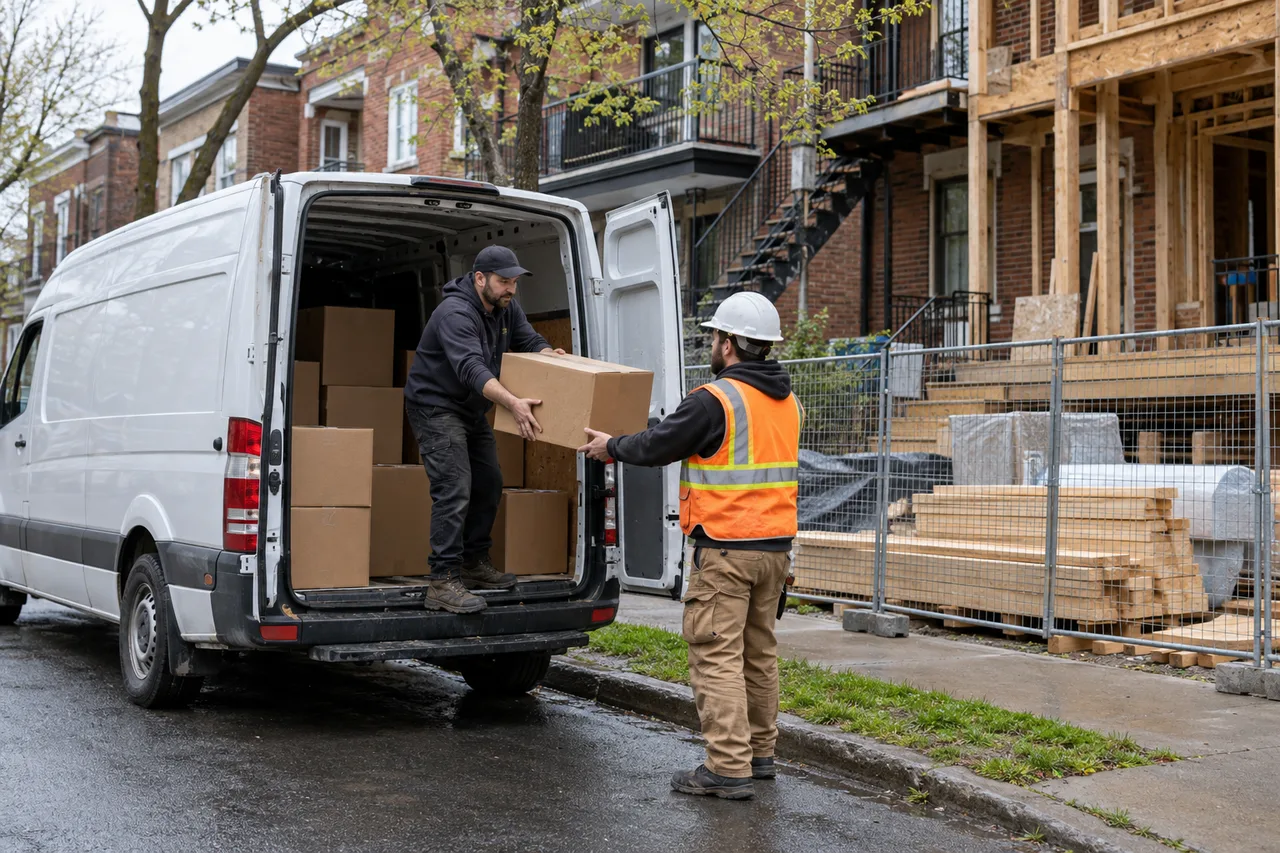
A heavy order gets delivered before the thaw period, an urgent one goes out in a light vehicle during it. Add one step that costs nothing: in spring, log every order that was split, delayed or sent out urgently. Next winter, that list becomes your early delivery plan.
To build that plan with a carrier that separates heavy from light, describe your spring volumes in a quote request.
Frequently asked questions
When does the thaw period start in Montreal?
The thaw period in Montreal follows the zone 1 dates for southern Quebec. In 2026, it ran from Monday, March 16, at 12:01 a.m. to Friday, May 15, at 11:59 p.m. Depending on the weather and road conditions, the Ministère can move the start and end earlier or later. The 2026 dates were published in February, which makes February the time to look for the 2027 dates.
Are delivery vans subject to load restrictions?
Generally, no. Thaw period load restrictions apply to heavy vehicles, meaning those with a gross vehicle weight rating of 4,500 kg or more. A delivery van or cube van usually falls below that threshold. The GVWR appears on the manufacturer’s label, on the door frame. Ask the carrier for this information before trusting it with a heavy order in the spring, while the thaw restrictions are in effect.
Do the restrictions also apply to residential streets?
Yes. The Ministère specifies that permitted load limits are reduced during the thaw period on all public roads, not just highways. A heavy truck delivering to a job site on a neighbourhood street, in Laval or Brossard, must therefore respect the same load reduction. The annual reminder also targets shippers, and that includes the wholesaler who prepares the order and loads it onto the truck.
Why do trucks have to reduce their loads in spring?
Because the roadbed loses a good part of its bearing capacity when the ground thaws. Meltwater builds up under the asphalt and, according to the Ministère, the road becomes 30 to 70% more fragile than usual. A single overloaded truck can then damage it, while a small reduction in load greatly reduces the damage. Generally speaking, the load restrictions imposed on heavy vehicles range from 8 to 20%.