Summary
- The cut-off time is worked backward from the courier’s pickup
- A zone built from postal codes works better than a radius on a map
- The price shown to customers is not the price of the run
- Quebec law requires disclosing the delivery time, the carrier and the fees
- Five businesses where same-day delivery really pays off
- The order is packed before the courier rings the bell
- Before you offer same-day delivery to your customers
- Frequently asked questions
Key takeaways: To offer same-day delivery, a business sets four things: a cut-off time worked backward from the courier’s pickup, a zone defined by postal codes, clear fees and fast order preparation. In Quebec, the delivery time, the carrier and the fees must be shown before purchase.
“If I order now, will it arrive tonight?” A Mile End stationery shop that decides to offer same-day delivery will get that question sooner or later.
The answer depends less on the courier than on four decisions made in the store: when the promise stops, which addresses it covers, what it costs and how orders get prepared at the counter.
Delivery time weighs on the decision to buy here. In Université Laval’s NETendances 2025 survey on online shopping, conducted in January 2026, 48% of Quebec online shoppers say delivery fees discourage them from buying from a Quebec merchant, and 19% cite delivery times. Purchases under $100, the typical basket at a stationery shop, are most often decided the same day (56%).
The cut-off time is worked backward from the courier’s pickup
The right starting point is the time of the last possible pickup at your store, whatever time competitors advertise. If that pickup happens at 2 p.m., an order takes 30 minutes to prepare and a 15-minute buffer absorbs the unexpected, the cut-off time shown becomes 1:15 p.m. Showing 2 p.m. promises a departure the team will miss as soon as an order comes in at 1:55 p.m.
The holiday season needs its own cut-off: a 25-item order on December 20 does not get packed at the pace of a Tuesday in March. Moving the cut-off up by an hour during those weeks costs a few sales and prevents a string of late deliveries.
The carrier’s side is covered in how a delivery run unfolds.
A zone built from postal codes works better than a radius on a map
A 15 km radius around a warehouse in Saint-Laurent takes in a good part of Laval and almost all of downtown. At 3 p.m., though, a run that crosses the Rivière des Prairies does not have the same delivery time as a trip to Outremont.
Shopify’s help centre, consulted on October 26, 2026, explains how to limit local delivery to a radius or a list of postal codes, and entering the first characters of a code is enough to include an entire area. Those three characters form the forward sortation area: Laval’s start with H7, Brossard’s with J4. The same logic applies elsewhere: WooCommerce also lets you limit a shipping zone to specific postal codes, one per line. Opening the island and Laval first, then adding the South Shore once delivery times hold, limits the risk.
A common trap: according to the same page, as of that date, local delivery works with Shop Pay but not with other accelerated checkouts such as Apple Pay, Google Pay or PayPal. A customer who picks one of them never sees the option. This rule changes often, so a test order before launch settles it.
The price shown to customers is not the price of the run
A run costs more or less depending on distance, time of day, volume and urgency, as explained in the article on what drives the price up. At checkout, the buyer sees only one amount, and three formulas are used to set it.
- Flat fees by zone. One amount for the island and Laval, another for the South Shore. Easy to read, but the business absorbs the difference on more expensive runs.
- Free above a threshold. Same-day delivery becomes free above a certain basket size. The average basket goes up, provided the threshold covers the run.
- Absorbed fees. No fee is shown, and the cost goes into product prices. This works for large baskets, rarely for small orders.
The threshold is calculated with gross margin rather than revenue. With a 40% margin, every dollar of fees absorbed requires $2.50 in extra sales to break even. On a $30 basket, the gross margin is $12, and that $12 has to pay for the run, the packaging and the preparation time.
Before setting those fees, get a price for a run from your address: a quote request that lists your most frequent postal codes is enough.
Quebec law requires disclosing the delivery time, the carrier and the fees
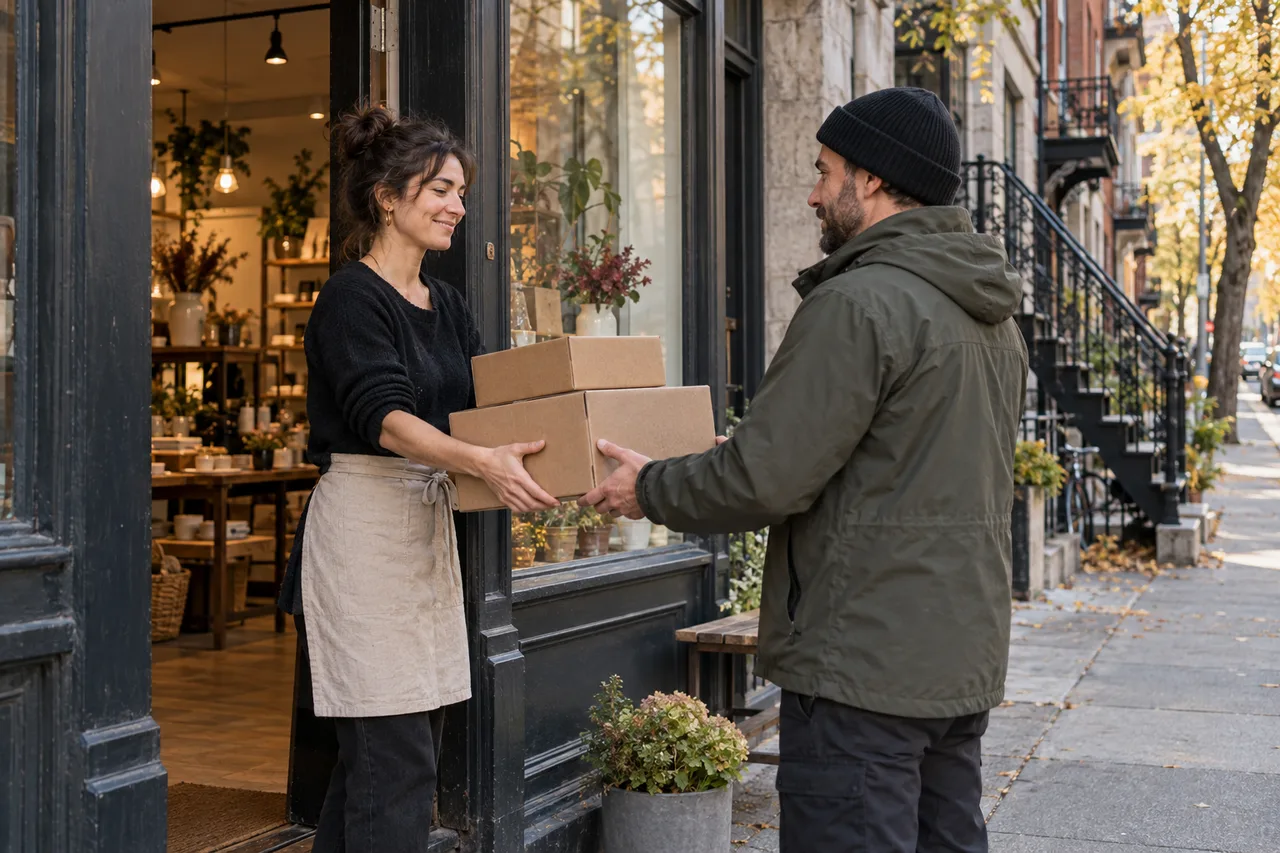
In Quebec, an online sale is a distance contract. The Office de la protection du consommateur lists the information to provide before the purchase is concluded: the price of each item, shipping fees, the total payable, the delivery date or time frame, the delivery method, the carrier’s name and the place of delivery. The customer must also be able to accept, correct or cancel the order before paying.
Florists and caterers, take note: that page from the Office, updated on March 5, 2025, excludes from these rules the sale of goods that can perish quickly.
A line reading “Delivered today” is therefore not enough. A complete version would look more like this: “Ordered before 1:15 p.m., Monday to Friday, delivered the same day by courier in the areas shown. Fees displayed at checkout.”
According to the Office, consumers can cancel the contract at any time if they have not received the goods within 30 days of the date stated in the contract. A delay of a few hours is far from that threshold, but a customer expecting it the same evening notices.
A dated record of each attempt protects the merchant: if they tried to deliver on the agreed date and the customer prevented it, they are presumed to have met their obligation, according to the same page.
Five businesses where same-day delivery really pays off
Five types of businesses benefit, each with its own key setting.
| Business | What the customer is really buying | Setting that matters most |
|---|---|---|
| Gift shop, florist, chocolatier | A party tonight, a forgotten gift to make up for | Clear cut-off time, delivery before dinner |
| Parts or supplies distributor for professionals | A job site or shop that cannot stop | Two pickups a day, zone centred on industrial areas |
| Electronics and accessories store | A charger or adapter before a presentation | Accurate online inventory, or the promise falls apart |
| Specialty grocer, caterer | A platter for a reception that same evening | Narrow time window, insulated packaging |
| Stationery, office supplies | A business order needed before a meeting | Delivery before reception closes |
The parts distributor is the only case where a morning pickup matters more than the cut-off time: a shop that stops at 9 a.m. will not wait for the 2 p.m. run. A basic clothing store, on the other hand, often gains more from reliably delivering in two days. The receiving business’s side is covered in same-day delivery for businesses.
The order is packed before the courier rings the bell
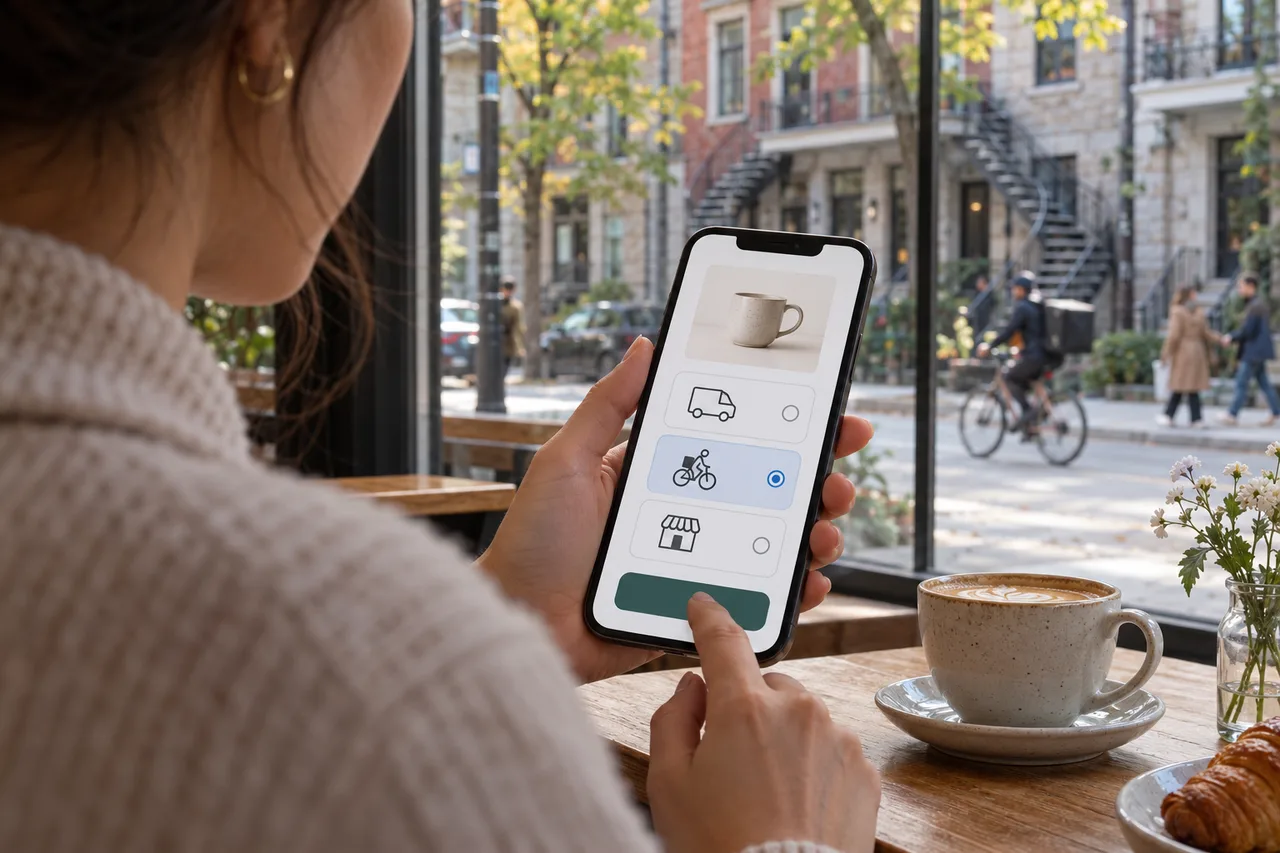
Back to the Mile End stationery shop. At 1:10 p.m., five minutes before the cut-off, an order comes in: a planner, going to an address in Saint-Henri. The counter is busy, no one hears the notification, and the 2 p.m. courier leaves without the parcel.
A separate alert for same-day orders, whether a sound or a dedicated printer, would have made it stand out. Boxes prepared ahead of time in the best-selling sizes save those last few minutes.
The recipient’s phone number and access instructions, such as a door code or a reception desk closed over lunch, prevent a second trip. A notice when the parcel leaves then cuts down on calls.
Before you offer same-day delivery to your customers
Note the time of the last pickup and subtract preparation time and a buffer. Open the option to the island and Laval. Set fees your gross margin can carry, show the delivery time, carrier and fees at checkout, then track the share of orders delivered on time for two weeks: if it disappoints, move the cut-off earlier or shrink the zone.
That is all the Mile End stationery shop needs to offer same-day delivery without watching the 2 p.m. courier leave empty-handed.
The terms of a same-day delivery service can be compared from your address before you add the option at checkout.
Frequently asked questions
How can a business offer same-day delivery to its customers?
A business that wants to offer same-day delivery sets four things, once it has signed an agreement with a courier that picks up every day at a fixed time. It works out a cut-off time backward from that pickup, defines a zone by postal codes rather than by radius, shows its fees at checkout and speeds up order preparation. In Quebec, the delivery time and the carrier must be disclosed before purchase.
Should customers be charged for same-day delivery?
Not necessarily, but its cost has to be covered somewhere. There are three formulas: flat fees by zone, free delivery above a basket threshold, or fees absorbed into product prices. The threshold is calculated with gross margin: at a 40% margin, every dollar absorbed requires $2.50 in extra sales. Compare that calculation with the real cost of a run from your address before choosing a formula.
What does a business risk if a promised delivery arrives late?
Mostly the customer’s trust, and sometimes the sale. In Quebec, an online buyer can cancel the contract if they have not received the goods within 30 days of the agreed date. A merchant who tried to deliver on the planned date, but whom the customer prevented from doing so, is presumed to have met their obligation, which is why a dated record of every attempt is useful.
