Summary
- The 2025-2027 plan starts at the curb
- What the by-law allows in a delivery zone
- 946 zones counted, and most close on Friday evening
- Four street segments under watch, but which ones?
- Matching your deliveries to the sign, not the other way around
- What Montreal delivery zones demand from retailers in 2026
- Frequently asked questions
Key takeaways: Montreal delivery zones are reserved for trucks and commercial vehicles, only for the time needed to load or unload. The 2025-2027 urban logistics action plan does not change that rule: it steps up enforcement, reviews where zones are located and prepares delivery time windows.
A car is sitting in the delivery zone in front of a boutique on Saint-Laurent Boulevard. The van bringing its order circles the block, then stops in the traffic lane, double-parked. Of the 946 Montreal delivery zones counted by the City, 39 line this boulevard, more than any other street.
The scene costs the boutique time, and sometimes a missed delivery. It is also the first problem tackled by the City’s urban logistics action plan.
The 2025-2027 plan starts at the curb
On July 11, 2025, the City of Montreal unveiled its first urban logistics action plan: 20 actions spread across ten objectives. The first objective is about the sidewalk: making better use of the curb space reserved for deliveries.
The starting point is spelled out in black and white. In the 2025-2027 Action Plan published by the City, the Agence de mobilité durable notes that “the majority of delivery zones in commercial areas are regularly used in an inappropriate, non-compliant and often dangerous way.”
As of December 31, 2025, according to the progress report posted on the same page, 3 actions were completed, 13 were underway and 3 had been initiated.
This article sticks to the sidewalk in front of your business. For an overview of the plan’s priorities and its 2050 vision, read the article on Montreal’s urban logistics plan.
What the by-law allows in a delivery zone
Parking falls under the boroughs. In Ville-Marie borough, the one with the most zones, section 44.1 of the borough’s By-law concerning traffic and parking (R.B.C.M., c. C-4.1) allows the driver of a truck or commercial vehicle to park there. The driver may stay only as long as needed to load, unload or drop off a small parcel.
The same by-law provides useful leeway when the zone is taken:
- Residents-only zone. A truck or commercial vehicle may stay up to 60 minutes during continuous loading, and a commercial vehicle up to 15 minutes for mail or a small parcel.
- Parking meter. The driver may park without paying for 30 minutes to load or unload, and 15 minutes for a small parcel.
- Lane. Loading is allowed, provided it is done continuously.
- Street closed to trucks. A truck may park there for the time needed for a local delivery, and no longer.
- Exceptions that don’t apply. These allowances fall away when a prohibition is posted near a construction site, an event, a school, a playground or a park.
These rules come from the Ville-Marie consolidation, current to September 5, 2026. Each borough keeps its own version, so section numbers and allowed times may differ. Check your borough’s version, then read the sign in front of your door.
946 zones counted, and most close on Friday evening
Between October 2025 and May 2026, City teams located every signed zone in the field. The result is published in the open data set on on-street delivery zones, which has no legal force, the City points out: the sign is what counts.
The file, in its September 23, 2026 version, shows a two-speed city. Ville-Marie has 216 zones and Le Plateau-Mont-Royal 213, or 45% of the total. No zones are listed in Anjou, Montréal-Nord, Saint-Léonard, Pierrefonds-Roxboro or L’Île-Bizard-Sainte-Geneviève.
Read from a receiving standpoint, it looks like this:
| What the signs say | Number of zones | What it means for receiving |
|---|---|---|
| Monday to Friday only | 695 of 946 | On Saturday, they are no longer reserved for deliveries |
| Available every day | 185 | The only reliable option for a Sunday delivery |
| At all times, no time window | 132 | Early morning or evening deliveries possible |
| Period ending at noon or earlier | 195 | The afternoon delivery loses its spot |
| Less than 10 m long | 155 | One van only, no straight truck |
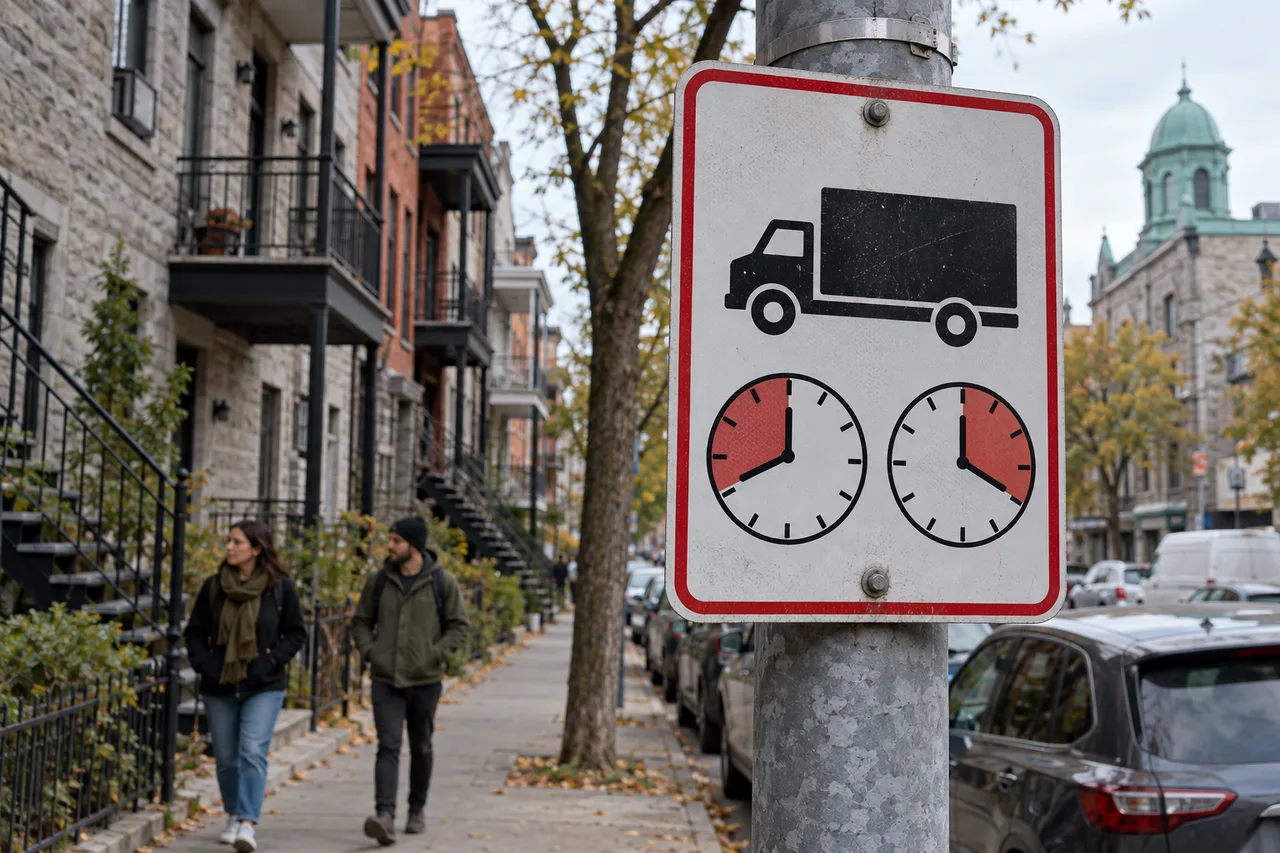
The 195 zones that close at noon or earlier mostly trap afternoon routes. A supplier who always drops by around 2 p.m. is unknowingly aiming for a spot that has not been reserved for deliveries for two hours.
Four street segments under watch, but which ones?
The plan gives the Agence de mobilité durable the job of monitoring two situations: a personal car parked in a delivery zone, and a truck stopped in the street in a dangerous or non-compliant way. It announced a pilot project “targeting four street segments in the Ville-Marie and Plateau-Mont-Royal boroughs.”
The segments are not named: neither the plan, nor its 2025 progress report, nor the Agency’s 2025 annual report identifies the streets selected. The progress report only states that the pilot project is complete.
Yet these two boroughs account for 429 of the 946 zones counted. A shop located there cannot rule out that its street will be part of what comes next, especially since the plan calls for reviewing where existing zones are located and adding new ones on commercial arteries.
Two other initiatives follow. The City is testing delivery time windows outside peak pedestrian hours on a few arteries, with a report expected in 2026. Its new signs governing certain heavy truck turns are awaiting approval from Quebec’s Ministère des Transports, for 2027.
If a supplier still drives a heavy truck onto your commercial street, a quote request that specifies the address and the length of the nearest zone can be used to price distribution in light vehicles.
Matching your deliveries to the sign, not the other way around
Most delivery headaches can be solved without waiting for the City.
- Take a photo of the sign. Note the days, the time window and the length of the nearest zone.
- Align the receiving window. A zone valid from 6 a.m. to noon calls for a delivery before noon. Write it on the supplier’s purchase order.
- Ask which vehicle will be used. A 10 m truck in an 8 m zone ends up double-parked. The question comes up as soon as the order is placed.
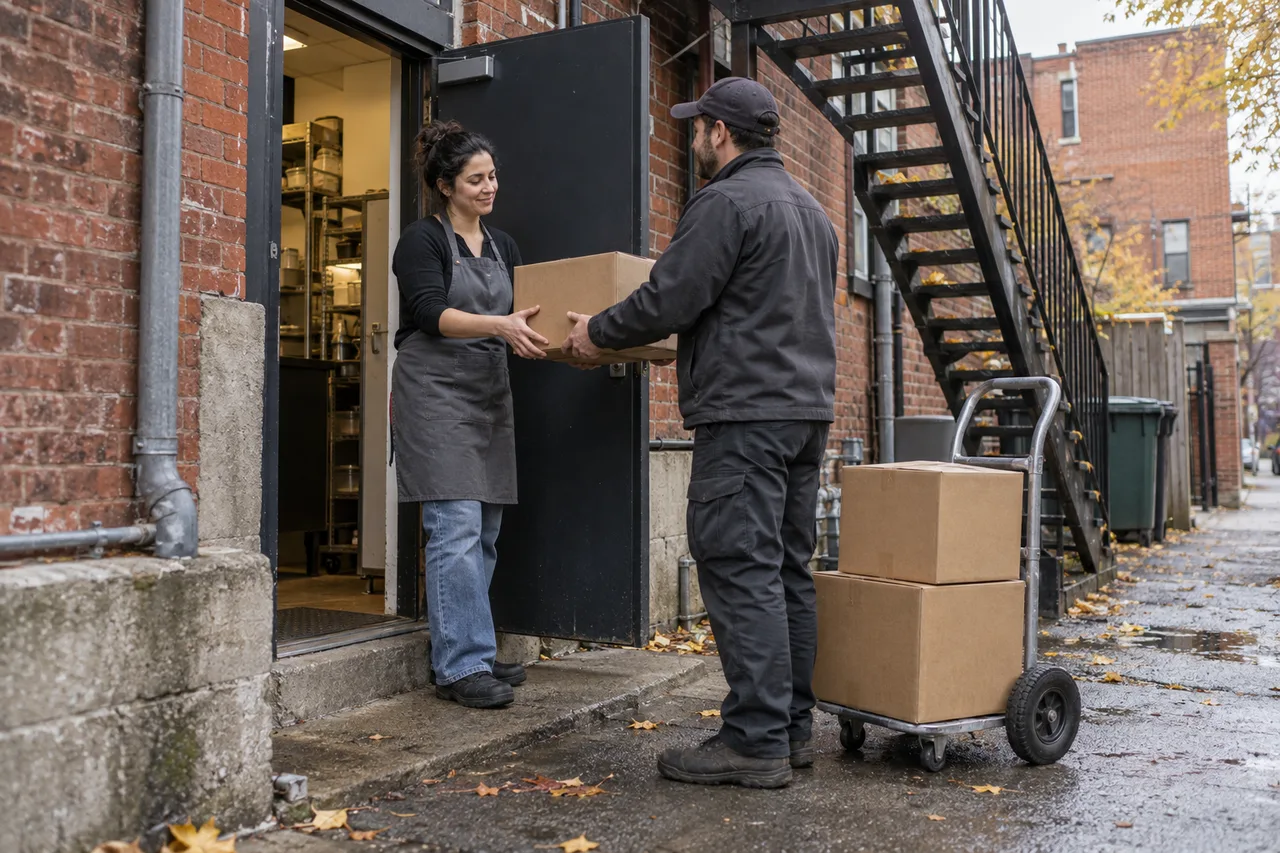
- Give the person receiving a heads-up. A driver waiting for someone to open the back door quickly goes over the time needed to unload, the only time the by-law allows.
- Have a written plan B. A lane, a neighbour’s loading dock or a rear entrance: the fallback is negotiated ahead of time.
For small parcels in dense areas, a cargo bike fits easily into the 155 zones too short for a straight truck. For shipments from the store to its own customers, a retail delivery service can schedule its stops at times when the zone is free.
What Montreal delivery zones demand from retailers in 2026
Parking rules did not change with the plan. What changes is the likelihood of being checked, the review of zone locations and the pressure to deliver in smaller vehicles. In front of each of the Montreal delivery zones, the sign says what matters: a commercial vehicle, continuous loading, during the posted hours.
A retailer who knows the time window and the length of its zone can require a vehicle that fits. To organize these deliveries with urban logistics suited to Montreal streets, include your address and your delivery days in a quote request.
Frequently asked questions
Who is allowed to use Montreal delivery zones?
Trucks and commercial vehicles. Montreal delivery zones are reserved for them, only for the time needed to load, unload or drop off a small parcel, under each borough’s traffic by-law. A personal car has no place there, even briefly. Also check the days and hours shown on the sign: outside that window, the space goes back to being ordinary parking open to all other vehicles.
How long can a delivery driver stay parked to make a delivery?
As long as needed, and no longer. In a delivery zone, no fixed time limit applies. Elsewhere, the Ville-Marie by-law allows 60 minutes for continuous loading in a residents-only zone, 15 minutes for a small parcel, and 30 minutes without paying at a parking meter. These allowances fall away in front of a sign near a school, a park or a construction site, and may vary from one borough to another.
Does the urban logistics plan ban trucks downtown?
No. The 2025-2027 Action Plan does not ban trucks downtown. It calls for testing delivery time windows on a few targeted arteries and for new signs governing certain heavy truck turns, planned by 2027. The trucking rules already in force continue to apply. A retailer supplied by tractor-trailer would be wise to ask its supplier right now which vehicle it plans to use for its deliveries.
Is the City’s delivery zone map legally binding?
No. The open data set “Aires de livraison sur rue” lists 946 zones located in the field between October 2025 and May 2026, with their days, hours and length. The City specifies, however, that it has no legal force. The sign posted in front of the zone is what counts, and it may have changed since the survey. The file is mainly useful for locating the zones in an area before a new route.