Summary
- The pharmacist’s responsibility follows the bag to the door
- Sorting urgent prescriptions before calling a courier
- The handoff to the patient is described before the first run
- What patients can expect from their pharmacy
- Five questions that set couriers apart
- Organizing medication delivery without handing off responsibility
- Frequently asked questions
Key takeaways: Medication delivery is part of the pharmacist’s service right up to the handoff to the patient. When it is entrusted to a courier company, it requires a written contract, a grid that separates urgent prescriptions from scheduled routes, delivery hours set by the pharmacy and a hand-to-hand delivery, never in a public place.
The Ordre des pharmaciens du Québec does not set any delivery time in hours. That silence does not make the job easier: each pharmacy has to decide for itself what is urgent, put it in writing and deliver within a reasonable time for its clientele. In Montreal, medication delivery is therefore settled at the counter, well before the courier arrives.
An antibiotic to start before dinner, a pill organizer prepared for Thursday and a stock transfer to another branch do not leave at the same time or in the same vehicle.
This guide is for the pharmacist-owner, whether deliveries are made by an employee or an outside company: the responsibility never leaves the pharmacy. Patients waiting for their bag will find further down what they can expect.
The pharmacist’s responsibility follows the bag to the door
For the Ordre des pharmaciens du Québec, delivering a medication is an extension of the professional service. The pharmacist’s ethical obligations continue until the handoff to the patient, or to the person the patient has designated.
These obligations are the same for an employed driver, a self-employed worker or a delivery company. In the last two cases, the Ordre requires a formal contract that covers, among other things:
- Confidentiality of information. The driver signs a commitment form, and the bag label shows only the name, the address and the amount to be paid.
- Hygiene rules, named in the contract just like confidentiality.
- Protection against theft. Doors locked between stops, packages out of sight, medications stored in a locked container.
- Measures against errors. A dedicated area for bags to be delivered avoids mixing up a delivery with an order waiting for the patient at the counter.
- Liability insurance, which the carrier must hold.
The Ordre also expects minimum checks on the driver: employment history, driving record and, where applicable, judicial, civil or criminal records. A company that cannot explain how it screens its drivers leaves the pharmacy carrying a risk it cannot see.
Sorting urgent prescriptions before calling a courier
The Ordre asks for three specific things regarding timing: setting delivery hours, providing for exceptions outside those hours and identifying urgent situations in advance. The patient receives the medication within a reasonable time, given the urgency and the clientele.
Four categories cover most prescriptions at a neighbourhood pharmacy, and posting them near the counter keeps the team aligned even on a busy Saturday:
| Type of shipment | Example | Suitable delivery method | Check before departure |
|---|---|---|---|
| Treatment emergency | Antibiotic or painkiller to start today | Direct run, no other stops | Deadline confirmed with the patient |
| Refrigerated product | Insulin, vaccine, some biologic drugs | Direct run in an insulated container | Container ready and closed at departure |
| Transfer between branches | Stock shortage to fill the same day | Dedicated run or end-of-day route | Person named to receive it |
| Scheduled delivery | Pill organizer, monthly renewal | Route grouped by area | Delivery time recorded in the file |
A refrigerated product leaves on a direct run even when it is not urgent: each stop on a route adds a door opening and more minutes outside the fridge. At a Montreal neighbourhood pharmacy, this case is far from rare: according to Montreal public health’s key figures, 26.7% of Montrealers aged 65 and over were living with diabetes in 2023-2024, or 98,855 people. The container and protection against both heat and cold are covered in the article on temperature-controlled pharmaceutical delivery; here, only sorting matters.
The departure time matters as much as the category. A transfer from Rosemont to a branch in Sainte-Rose, in Laval, that leaves at 4 p.m. drives straight into rush hour; leaving at 2:30 p.m., it has a good chance of arriving ahead of it. Treatment emergencies, for their part, call for same-day delivery rather than the route.
When these late-afternoon emergencies overflow the route, a quote request describing a typical day, with its busy hours, makes it possible to price direct runs as a complement.
The handoff to the patient is described before the first run
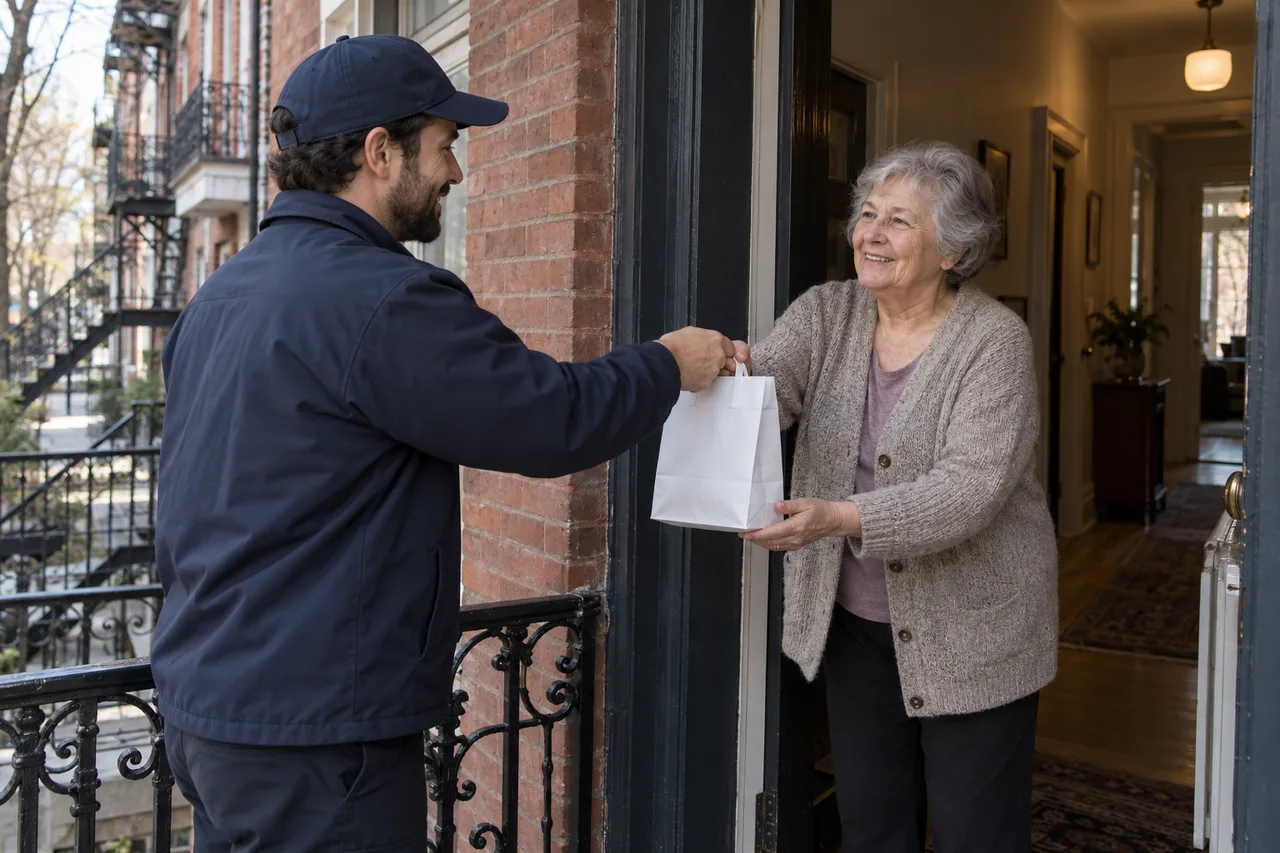
A triplex on the Plateau, a spiral staircase, a doorbell that goes unanswered. Leaving the bag in the shared vestibule seems convenient. The Ordre forbids it: a package of medications is never left in a public place.
Two regulated exceptions exist. At the patient’s request, a secure locker with electronic access can be used. The bag can also be hung on the door handle, to keep a distance, provided the driver sees the recipient pick it up before leaving.
Identity is confirmed at every handoff. If the driver does not recognize the patient, a second piece of identification is requested; if a relative receives the bag, their name is recorded in the file. A two-step signature log, from the pharmacy to the driver and then from the driver to the patient, then proves that the medication did arrive.
For absences, the written procedure says what to do when no one answers, how soon the bag comes back and where it is put depending on why it was returned, whether the patient was absent or the medication is to be destroyed.
The Ordre also points out that this service often serves a vulnerable clientele with declining autonomy. The same public health figures show it: in Montreal, 117,310 people aged 65 and over were living alone in 2021, or 37% of seniors in private households. A driver who has been told that an 85-year-old woman takes time to come down her stairs waits, instead of leaving after one ring.
What patients can expect from their pharmacy
Patients do not have to accept a bag left in the lobby. They can expect a reasonable time frame based on how urgent their treatment is, and confirmation of the delivery time when it is set in advance in their file.
They can designate a relative to receive the bag, whose name will be recorded in the file, or ask for a secure locker. If they prefer mail, the pharmacy notes that choice and keeps proof of receipt, a signature or a follow-up call. If a rule is not followed, the Ordre accepts requests for inquiry from the public.

Five questions that set couriers apart
Before signing, ask these five questions:
- Does the driver sign a confidentiality commitment specific to the pharmacy, and can a copy be provided?
- What liability insurance covers the medications being transported, and can proof be sent before signing?
- Does a treatment emergency leave on a direct run, without waiting for the vehicle to fill up?
- What does the driver do when the patient is not home, and how soon does the bag come back to the counter?
- How is the patient’s signature captured and sent to the pharmacy for its records?
Get the answers in writing and attach them to the contract: they are what the pharmacy will show if a patient complains about a lost bag.
A pharmacy with several branches benefits from entrusting all its runs to the same pharmacy delivery service, which serves Laval and both shores: a single procedure, signed once, then covers every address.
Organizing medication delivery without handing off responsibility
Sign the contract, post the sorting grid near the counter, record the delivery hours and their exceptions, then write the handoff and return procedure. With these four documents, medication delivery changes hands without changing who is responsible.
A carrier is then judged on a real week: the end-of-day emergencies, a transfer to Laval and a few refrigerated shipments. Have that week priced in a quote request, with the share of shipments that cannot wait.
Frequently asked questions
Can a pharmacy hand off medication delivery to a courier company?
Yes. Medication delivery can be entrusted to a self-employed worker or a delivery company, but the Ordre des pharmaciens du Québec then requires a formal contract. That contract covers confidentiality of information, hygiene rules, protection against theft, measures against errors and liability insurance. The pharmacist’s obligations remain the same as they would be with an employed driver working directly for the pharmacy.
Can the driver leave the medications at the door?
No, not in a public place. The rules of the Ordre des pharmaciens du Québec forbid leaving a package of medications in a public place, such as a shared vestibule. At the patient’s request, a secure locker with electronic access can be used, and the bag can be hung on the door handle if the driver sees the recipient pick it up. Otherwise, the bag returns to the pharmacy according to the planned procedure.
Does a pharmacy have to deliver a prescription within a set time?
No, no specific time limit is imposed. The Ordre des pharmaciens instead asks for a reasonable time, set according to the urgency of the situation and the clientele served. Each pharmacy sets its delivery hours, provides for exceptions outside those hours and identifies urgent situations in advance, such as a treatment to start the same day. Write these criteria into the procedure so the whole team sorts the same way.
