Summary
- The stability limit sets the pickup time, not the other way around
- The health professional classifies the specimen, and the class decides the box
- The P650 box combines three layers, a marking and an emergency number
- The courier must hold their own training certificate
- What to ask the courier before the first cooler
- Writing the clinic’s biological specimen transport procedure
- Frequently asked questions
Key takeaways: Biological specimen transport rests on three decisions made by the clinic: classifying the specimen (exempt specimen, Category B or Category A), packing it in a compliant box such as the P650 marked UN3373, and handing it to a courier with a valid TDG training certificate, in time to meet the stability limit.
In August 2019, the Ordre professionnel des technologistes médicaux du Québec, the Ordre des chimistes du Québec and the Société québécoise de biologie clinique published the benchmark that governs biological specimen transport in Quebec: two hours for a non-stabilized potassium, from collection to centrifugation or analysis.
A complete blood count, drawn at the same minute and placed in the same cooler, gets four. On top of these two clocks comes a federal regulation that decides the box, the marking and the driver’s training.
The stability limit sets the pickup time, not the other way around
The guide to the transport and storage of specimens published by these three organizations gives maximum times for non-stabilized specimens: 2 hours for glucose, potassium and LDH, 4 hours for CBC, phosphorus and routine urinalysis.
Transport “must be set according to the shortest stability limit,” the guide states. That limit includes the trip, receiving and sorting at the lab.
A potassium drawn at 2:30 p.m. must therefore be centrifuged or analyzed before 4:30 p.m. Allow 20 minutes for receiving and sorting, then 35 minutes of rush-hour driving on the Metropolitan Expressway: the courier has to leave the clinic by 3:35 p.m. at the latest. These two durations are for illustration only; ask your lab for its own.
A route set at 4 p.m. out of habit dooms that tube, however carefully it is packed. For a late collection, same-day delivery with a direct departure often solves the problem.
The health professional classifies the specimen, and the class decides the box
According to the Transport Canada page on shipping infectious substances, updated in September 2026, “professional judgment is required” to conclude that a specimen does not contain an infectious substance. Medical history, symptoms and local conditions all factor into that judgment, which the courier does not have to make.
The reasoning reads from the simplest case to the most regulated:
| What the cooler contains | Classification | What must appear on the box | TDG training |
|---|---|---|---|
| Routine specimen, no reason to suspect an infectious agent | Exempt human specimen | The words “exempt human specimen” | Not required by the regulation |
| Patient specimen that may contain a Category B pathogen | UN3373, biological substance, Category B | UN3373 diamond, shipping name, 24-hour number | Yes |
| Culture or pathogen on the Category A list | UN2814 | Class 6.2 label, shipping document | Yes |
| Exempt specimen shipped with dry ice or formalin | The regulation applies again | Depends on the added substance | Yes, unless another exemption applies |
A bag of dry ice is enough to bring a routine specimen back under the regulation. Formalin has the same effect, even though the tube itself has not changed.
The Quebec guide goes further than the law: even for an exempt specimen, the staff preparing the coolers must be able to recognize a regulated substance.
The same logic applies to equipment. Transport Canada includes blood, body fluids “or material contaminated by them” in infectious substances. An analyzer going back to the manufacturer with specimen residue therefore falls under that definition until it has been decontaminated. Once clean, it becomes a fragile package again: its handling is covered in the article on medical sector delivery, and a heavy device goes through large parcel delivery.
The P650 box combines three layers, a marking and an emergency number
Transport Canada describes Type P650 packaging, compliant with the CAN/CGSB-43.125 standard, as the box intended for UN3373. From the inside out:
- Layer 1, the leakproof primary receptacle. The collection tube or container, never reused for another shipment, surrounded by enough absorbent material to hold all the expected liquid.
- Layer 2, the leakproof secondary packaging. The bag or container that holds in a leak. Either it or the outer box must be rigid.
- Layer 3, the outer box. Its smallest dimension measures at least 100 mm. It can be reused if it shows no visible contamination or damage.
- The Category B marking. A square set on its point with sides of at least 50 mm, with “UN3373” in characters at least 6 mm high and the shipping name “Biological Substance, Category B” right next to it.
- The 24-hour phone number. It appears on the box, near the shipping name.
These conditions open the door to the section 1.39 exemption in the regulation: a UN3373 shipment travels without a shipping document. Training for those who handle it remains mandatory.
For the 24-hour number, the CIUSSS de la Mauricie-et-du-Centre-du-Québec requires every facility that uses its coolers to be registered with CANUTEC, Transport Canada’s emergency centre.
If your end-of-day specimens regularly miss the cut-off time, put that time and the most fragile analyte in a quote request, so the pickup is planned from there.
The courier must hold their own training certificate
The Transport Canada bulletin on TDG training is clear: anyone who handles, offers for transport or transports dangerous goods must be adequately trained and hold a valid certificate. A person without a certificate may work only in the physical presence of a certified person.
The certificate expires 36 months after it is issued for road transport, and 24 months for air. The employer keeps the training record for up to two years after expiry.
The CIUSSS de la Mauricie-et-du-Centre-du-Québec has its nursing staff take a 40-minute online course on Category B. The certificate, signed by the employee and their manager, must be carried at all times.
Under the Quebec guide, the “carrier” also includes the taxi driver, the home collection worker and the physician who brings a cooler to the lab personally.
What to ask the courier before the first cooler
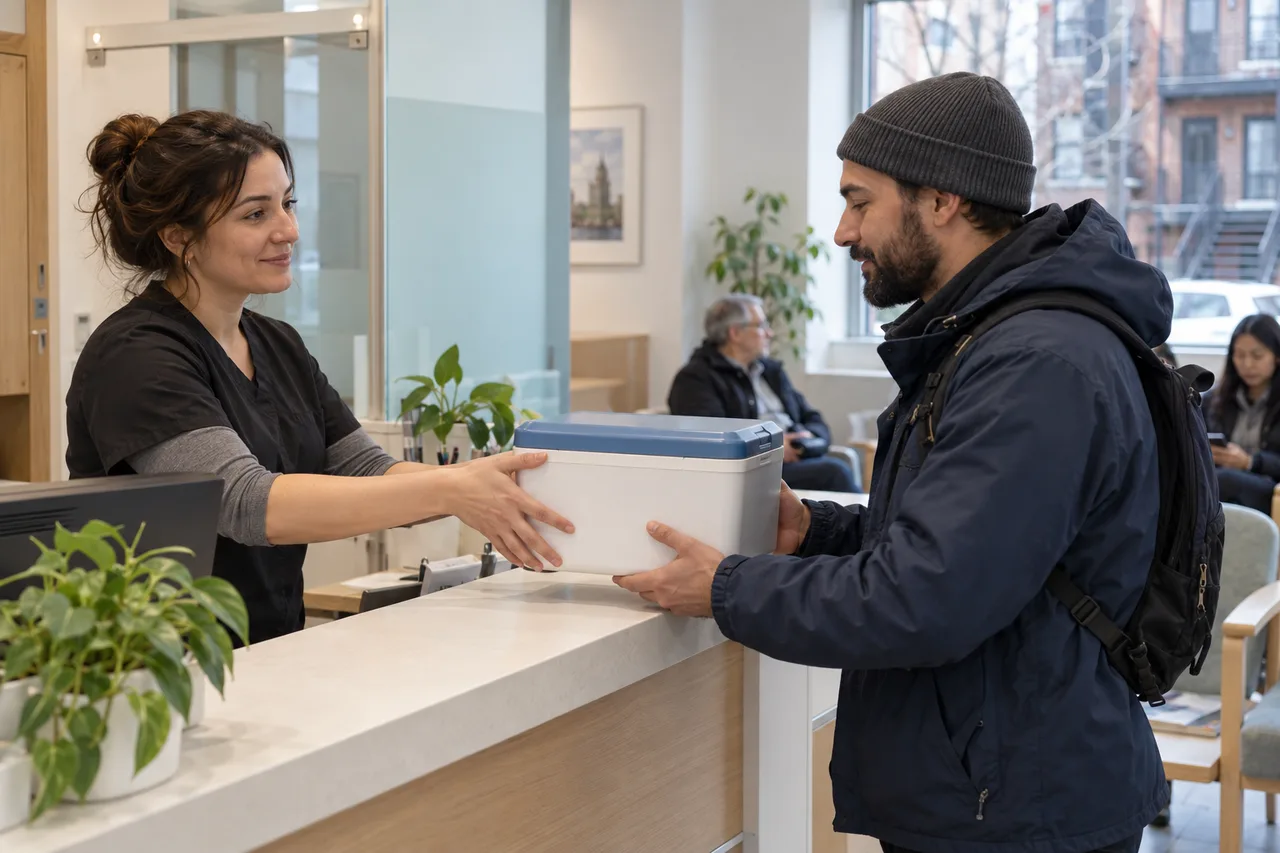
Before entrusting a first cooler to a courier service, ask for the expiry date of the certificate held by each driver assigned to the route. Also ask what they do if the box is crushed or leaks after business hours.
Then check that the cooler goes straight to the lab, without passing through a warehouse, at the required range: 4°C, ambient (between 18°C and 25°C according to the guide) or dual-zone. That last term refers to a cooler with two compartments that keeps, on the same trip, some tubes at 4°C and others at room temperature. The CIUSSS de la Mauricie-et-du-Centre-du-Québec quick reference warns that in extreme cold, tubes placed near the 4°C zone cool down quickly.
Finally, a time-stamped handoff proves to the lab the actual arrival time.
Writing the clinic’s biological specimen transport procedure
In biological specimen transport, the lab sets the time, the most fragile analyte sets the departure, the professional sets the class and the class sets the box. That leaves the driver’s certificate, which decides who can pick up the cooler.
These elements fit on one page, shared with the lab and the carrier, with a name to call when the cooler has not arrived on time.
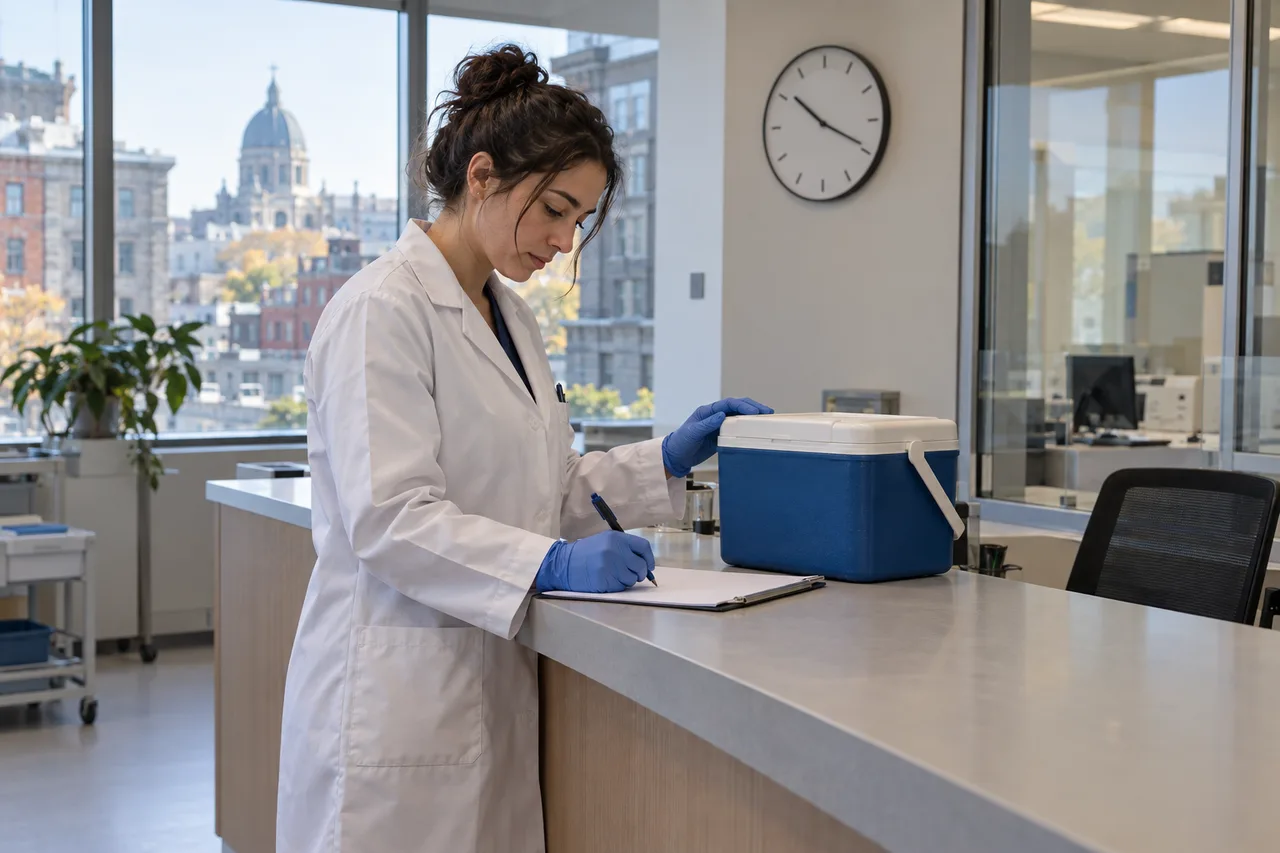
For a regular route, include your collection times, the lab’s cut-off time and the required temperature in your quote request.
Frequently asked questions
Who is responsible for biological specimen transport?
Not just the carrier. In biological specimen transport, the shipping clinic classifies the specimen, chooses the box and applies the markings. The carrier must recognize compliant packaging, keep the markings in place and know the emergency measures in case of a leak. The lab sets the time limits and temperatures. Each party answers for its own step: a classification error at the clinic cannot be fixed on the road.
Is training required to transport Category B specimens?
Yes. Transport Canada requires training and a valid certificate for anyone who handles or transports UN3373 substances, including the driver. The section 1.39 exemption removes the shipping document, but not the training. The road certificate expires after 36 months. Without a certificate, a person may only work in the physical presence of a certified person. Ask for the expiry date of each driver’s certificate before the first pickup.
What is triple packaging in a laboratory?
It is the Type P650 packaging required for UN3373 shipments. The leakproof tube forms the first layer, surrounded by enough absorbent material to hold all the liquid. A leakproof secondary packaging forms the second, and an outer box whose smallest dimension reaches 100 mm forms the third. One of the last two must be rigid. The tube is never reused; the other two layers can be, if they are intact.
Can a blood specimen travel without a cooler?
Sometimes. It all depends on the test ordered and the requirements of the lab that will perform it. Some tubes travel at 4°C, others at room temperature, which the Quebec specimen transport guide puts between 18°C and 25°C. Coolers also protect tubes from Montreal winters and summers. Check the receiving lab’s test directory before choosing the container and the temperature for each tube.